Is the Spiti Budget Itinerary at ₹16,599 Actually Worth It? A 7-Day Honest Breakdown
- 09 May 2026
Spiti Valley sits at an average elevation of more than 4,000 metres, and the road in only opens for about five months a year. So when a fixed-departure operator advertises a 6 nights / 7 days package starting at ₹16,599 per person (TOALT Spiti Budget Itinerary, 2026), the question worth asking isn't "is it cheap?" — it's "what does the price actually buy you, and what are you giving up at this tier?" This breakdown walks through the route, the altitude profile, the inclusions, the trade-offs, and the kind of traveller who'll get genuine value from the budget format.
Key Takeaways
- The triple-sharing price of ₹16,599 per person (plus 5% GST) covers Volvo transfers from Delhi, all in-Spiti transport, double-room accommodation, breakfast and dinner, permits, and a trip leader (TOALT, 2026).
- The route hits altitudes between 2,050m (Manali) and 4,587m at Komic — the world's highest village connected by a motorable road (Wanderon, 2026).
- Camping at Chandratal Lake (4,200m) is now restricted; authorised camps sit 2–3 km away, with a permit required since 2024 (Discover Kullu Manali, 2024).
- This itinerary suits acclimatised, cost-conscious travellers comfortable with long drive days and shared rooms; it isn't built for honeymooners or families with young children.
The published triple-sharing rate is ₹16,599 per person, with double sharing at ₹18,499, and 5% GST applies on both (TOALT, 2026). Inclusions cover round-trip overnight Volvo from Delhi to Manali, a tempo traveller for the full Spiti loop, all permits, breakfast and dinner (MAP plan), accommodation in 3-star and 4-star boutique stays, an experienced trip leader, oxygen cylinders, an oximeter, and a first-aid kit.
What's not included matters as much. Lunches across all seven days, parking and monument entry fees during sightseeing, additional costs from landslides or weather-driven delays, early check-in or late check-out fees, and any personal expenses sit outside the package. Realistic add-on spend for an honest budget traveller works out to ₹2,500–₹4,500 across the seven days, mostly on lunch, café stops in Kaza, and the occasional monastery donation.
The pricing assumes triple occupancy. If you're booking solo and can't fill the third bed, you'll either be matched with another solo traveller or pay the double-sharing rate of ₹18,499.
The seven-day flow is built around two overnight Volvo journeys (Delhi–Manali and Manali–Delhi) bookending five days of high-altitude exploration. Day 1 is the Delhi-to-Manali Volvo. Day 2 acclimatises in Manali. Day 3 crosses the Atal Tunnel and Kunzum Pass into Kaza. Day 4 covers the Kaza circuit — Langza, Hikkim, Komic. Day 5 moves to Chandratal. Day 6 returns to Manali. Day 7 lands back in Delhi by morning.
This sequence works because it stages altitude gain. Manali sits at roughly 2,050m, and a single overnight there before pushing into Kaza (3,800m) gives the body a buffer. The Atal Tunnel itself is 9.02 km long and runs at an altitude of about 3,060m, making it the world's longest single-tube highway tunnel above 10,000 feet (Wikipedia: Atal Tunnel, 2026). The drive from Manali to Kaza is the toughest single day on this trip — expect 9–11 hours including breaks, depending on weather.
A common rookie error on this route is treating Day 2 in Manali as a "free day" and over-exerting on local activities. The smarter play is treating it strictly as acclimatisation: short walks at Hadimba Devi or Vashisht, an early dinner, and a long sleep. The body recovers what the next day's altitude jump will demand.
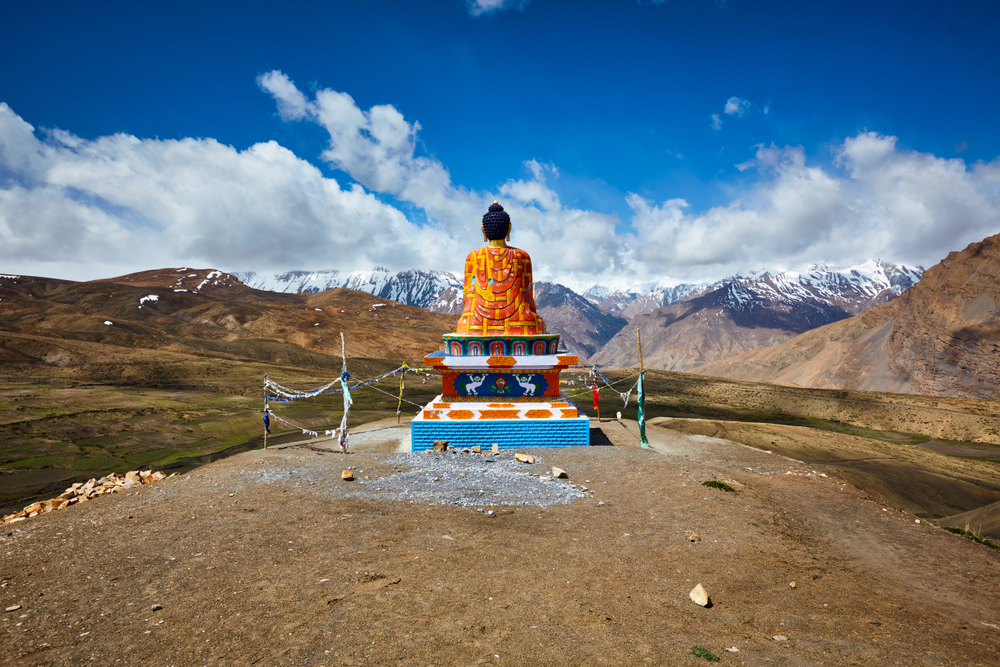
The Kaza circuit on Day 4 visits three of the world's highest permanently inhabited villages, and that's not a marketing line. Komic sits at 4,587m and holds the formal title of world's highest village connected by a motorable road, with Hikkim at 4,400m hosting the world's highest post office, and Langza at 4,420m anchored by its iconic Buddha statue (Wikipedia: Hikkim, 2026). On a clear morning, the views from Komic stretch across the entire Spiti basin.
What you actually do here is unhurried. Postcards posted from Hikkim genuinely take 4–6 weeks to arrive at most Indian addresses — a slow-mail novelty that has become the village's signature ritual. Langza's pre-monsoon sky lights up the Buddha statue against snow-streaked peaks, and Komic's Lundup Chhemo monastery, founded in the 14th century, is one of the oldest active Buddhist sites in India.
A practical note from previous batches: the Kaza circuit is run on Innovas or Boleros, not the larger tempo traveller, because the village roads are too narrow. That's already factored into the package, but it does mean shorter rotations of who sits where, and a slightly more cramped four-hour drive across the day.
Is the Chandratal Lake experience still as magical with the new permit rules?
Chandratal Lake sits at 4,200m and is now strictly regulated: wild camping at the lakeshore has been banned, authorised camps operate 2–3 km away, and an entry permit (₹150 for Indian nationals, ₹500 for foreign nationals) is now mandatory (Discover Kullu Manali, 2024). The TOALT package handles the permit on your behalf and stays at the authorised camps near the roadhead.
The trade-off is real. You no longer fall asleep with the lake five steps from your tent. But the ecological case for the rules is also real — Chandratal had been visibly degrading for years, with plastic accumulation and unregulated effluent. The new format protects the lake while preserving the experience that mattered most: the night sky.
That sky, on a clear night in May or June, is the single most-photographed moment of the entire Spiti circuit. With no urban light pollution within 100+ km, you'll see the Milky Way unaided, satellites tracking across the field of view, and meteor streaks if you're patient. Bring a head torch with red mode, a wide aperture lens if you shoot, and a windproof jacket — temperatures at the camp drop to 0–5°C even in late May (Travel Setu, 2026).
Who is this Spiti budget itinerary actually built for?
The package targets a specific reader: a 22–35-year-old solo or pair traveller who values experiences over comfort, has reasonable cardiovascular fitness, and doesn't mind shared accommodation or long drive days. TOALT explicitly positions itself as "a travel agency for solo travellers who love exploring in groups" with a 24-traveller cap that keeps the group small enough for genuine connection (TOALT About, 2026). On most departures, solo travellers form the majority.
It's not the right fit for honeymooners (the rooms are mostly twin-share, and Chandratal camps are basic), families with children under 12 (altitude exposure at Komic and Chandratal is genuinely risky for young kids), travellers with chronic respiratory or cardiac conditions (4,500m is no joke), or anyone who insists on lunch being included. People who book this trip and then complain about "basic" hotels in Kaza misunderstand what the budget format trades off.
A clean way to self-test: if you're willing to share a triple room with strangers to save ₹1,900, you're the target audience. If that idea feels claustrophobic, book the Spiti Valley Expedition at the higher comfort tier instead.
What does the budget format trade off compared to premium Spiti packages?
The ₹16,599 price is roughly 35–45% lower than premium Spiti operators in the same season, and the trade-offs are concentrated in three predictable areas: accommodation tier, lunch inclusions, and pace. Premium packages typically offer double-occupancy rooms throughout, 3 meals a day, and longer stays at signature stops. The budget tier consolidates rooms (triple sharing), drops lunch, and runs leaner on rest time.
The transport, the route, and the experiences themselves are largely identical. You're seeing the same Komic Buddha, the same Hikkim post office, the same Chandratal sky. The Atal Tunnel doesn't charge differently for budget Volvos. What you sacrifice is comfort margin — the difference between a hot shower with consistent water pressure and one that runs cold on Day 5, or between a private room and sharing one with two strangers.
A simple way to think about it: every rupee saved on the budget package is a rupee that buys you the same destination at lower comfort. If your travel goal is the experience, that math works in your favour. If your travel goal is comfort, it doesn't.
What altitude challenges should first-timers prepare for?
Three points on the route exceed 4,000m, and acute mountain sickness (AMS) becomes statistically meaningful above this threshold. Komic at 4,587m, Kunzum Pass at 4,551m, and Chandratal at 4,200m are all above the line where 25–30% of unacclimatised travellers report mild AMS symptoms (Travel Fika, 2026). The most common symptoms are headache, light nausea, fatigue, and sleeplessness — usually self-resolving within 12–24 hours if you hydrate and rest.
The package includes oxygen cylinders and an oximeter as standard kit, and the trip leader is trained to spot escalation early. That's a meaningful safety margin most independent budget itineraries don't offer. What's still on you: hydrate aggressively (3–4 litres of water per day), avoid alcohol entirely on Days 3–5, eat carb-heavy meals, and take Diamox only if your doctor has pre-cleared it.
A non-negotiable: if symptoms worsen — vomiting, shortness of breath at rest, confusion, blue lips — speak up immediately. The trip leader can route the affected traveller to lower altitude. Pretending you're fine when you're not is the single biggest cause of preventable evacuations on the Spiti route.
What practical preparation makes the biggest difference on this trip?
Three preparation moves will pay for themselves repeatedly: footwear, layering, and cash management. Good ankle-supporting trekking shoes (waterproof if you can stretch the budget) handle every terrain on this route — the slushy Komic morning slopes, the rocky path to the Chandratal lake viewpoint, the wet stone steps at Manali temples. Mall-rotation sneakers will leave you with blisters by Day 4.
Layering matters more than buying one heavy jacket. The May–June temperature swing on this route runs from 25°C in Manali at noon to -2°C at Chandratal at 3 a.m. (Travel Setu, 2026). A thin merino base, a fleece mid-layer, and a windproof outer shell handle the entire spectrum better than a single down jacket that's too warm half the time and too thin the other half.
Cash matters because Spiti is largely card-shy and ATMs are unreliable above Manali. Carry ₹4,000–₹6,000 in cash per person, broken into ₹100 and ₹500 notes. Most cafés in Kaza accept UPI now, but expect monastery donations, pony rides, postcards from Hikkim, and roadside tea stops to be cash-only.
Yes, with caveats. The package includes oxygen cylinders, an oximeter, and a trip leader trained in AMS recognition, and the day-by-day altitude profile follows a sensible acclimatisation curve (TOALT, 2026). First-timers should still consult a doctor about Diamox 1–2 weeks before departure, especially if they have any cardiac or respiratory history.
The Manali–Kaza route via Atal Tunnel and Kunzum Pass typically opens between mid-May and early June, depending on snow clearance and BRO road operations (Take A Break, 2026). The TOALT package's earliest 2026 batch (22nd–28th May) targets the road's opening window, with subsequent June batches running on confirmed access.
Moderate fitness covers it. The trip is mostly road-based with short walking stretches at villages and monasteries — no formal trekking. Daily exertion stays under 1–2 km of walking, but altitude exposure at Komic (4,587m) makes even short walks feel harder than at sea level (Wanderon, 2026). Anyone who can comfortably climb 4 flights of stairs at home will be fine.
The package uses two distinct vehicles: an overnight Volvo for the Delhi–Manali leg (reclining sleeper-style coach, 12–14 hours each way), and a tempo traveller within Spiti for daily sightseeing. Innovas or Boleros replace the tempo traveller for the Kaza circuit since the village roads are too narrow for the larger vehicle (TOALT itinerary, 2026).
Technically yes, but logistics get complicated. The Volvo return is a fixed booking, and skipping it means independently arranging Manali–Delhi transport during peak season when prices spike. A cleaner extension is adding 2–3 nights in Manali or Kasol before the trip starts, then joining the Day 1 pickup point in Delhi or Manali by prior coordination with the trip leader.
For the right traveller, the math on this package is genuinely hard to beat. ₹16,599 covers 6 nights of accommodation, all transport including overnight Volvos, two daily meals, permits, and a trained trip leader in one of India's most logistically demanding regions (TOALT, 2026). Independently arranging the same route through Manali agents typically costs 30–50% more once you factor in fixed-departure premiums, AMS support kit, and the hassle of permit coordination.
The "right traveller" is the operative phrase. If you're a solo or paired traveller in your 20s or 30s, comfortable with shared rooms, willing to skip lunch or grab quick local meals, fit enough to handle altitude with reasonable preparation, and primarily here for the experience rather than the comfort tier — this package will deliver. If any of those conditions break down, look at the higher-tier Spiti Expedition or a custom private trip instead.
The May and June 2026 batches are the road's first window of the year, with 22nd–28th May, 4th–10th June, and 18th–24th June as the published departures. Booking 30–45 days out lands you the best price tier and the least hectic batch sizes.
Ready to lock it in? Reserve your spot on the Spiti Budget Itinerary — the road only stays open for five months a year, and the budget batches sell out first.